The story in brief
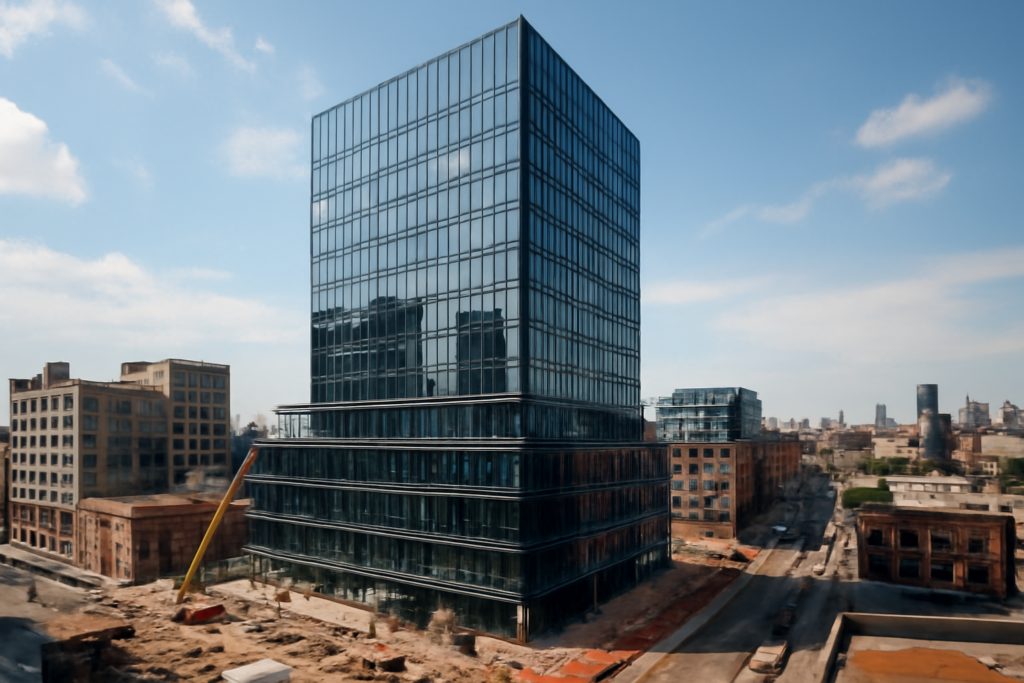
A 24-story office tower in Downtown Brooklyn is getting a second life as a mixed-use property after failing to attract office tenants.
Northwind Group originated a $208 million first-mortgage construction loan for 141 Willoughby Street. The financing will retire existing debt and fund the conversion of floors 8 through 23 into 239 rental apartments. The lower seven floors will remain commercial space under the property’s new branding, 385 Gold. The building contains approximately 355,000 square feet and was completed in 2023 but never occupied. RealtyWire Connect CRE
The project is being led by a joint venture between Capstone Equities and BH3 Fund Advisors. The sponsors acquired control of the property in 2025 and spent roughly a year in predevelopment before securing the new loan.
For passive commercial real estate investors, the transaction is more than another office-conversion headline. It illustrates how lenders and sponsors are separating potentially viable adaptive-reuse opportunities from the much larger universe of obsolete or economically impractical office buildings.
Why this building is unusually well suited to conversion
Office-to-residential conversions often fail before construction begins. Floorplates may be too deep, windows may be insufficient, plumbing locations may be inefficient, and structural or mechanical systems may require extensive reconstruction. Existing tenants can also create buyout obligations, relocation costs and legal uncertainty.
141 Willoughby avoids several of those problems.
According to the project details, the building was constructed to Class A institutional standards but never leased. That means the sponsors are not dealing with a long tenant roll, deferred maintenance from years of occupancy or complicated lease termination negotiations.
The tower also has a side-core design, relatively shallow floorplates and extensive exterior glazing. Those characteristics make it easier to create apartments with natural light and usable layouts. The project team expects the 15- to 17-foot slab-to-slab heights to produce residential ceilings that are higher than those found in many conventional apartment buildings.
That combination matters to underwriting. A building that is physically adaptable can reduce construction risk, shorten the conversion timeline and improve the likelihood that the finished units will compete effectively with new apartments.
It does not eliminate risk. The project still requires residential plumbing, kitchens, life-safety work, amenity construction, permitting, common-area redesign and lease-up. But the risk profile is different from converting a deeply obsolete office building with difficult floorplates and occupied tenants.
The financing is the more important signal
The $208 million loan is significant because it demonstrates that private credit is willing to finance a complicated repositioning when the asset has a credible alternative use and a strong urban location.
The lender is not simply betting on a broad recovery in office demand. It is underwriting a hybrid plan:
- Convert the upper floors to apartments.
- Preserve the lower floors as commercial space.
- Benefit from Downtown Brooklyn’s transit access and established retail infrastructure.
- Rely on a recently completed building rather than a heavily deteriorated property.
The mixed-use structure also gives the sponsor more than one source of potential value. Residential income can become the primary economic engine, while the commercial component retains exposure to a high-quality office market near MetroTech, Fulton Street and multiple subway lines.
For passive investors, this is an important distinction. Adaptive reuse is not automatically attractive simply because an office building is vacant. The investment case improves when the property can support multiple uses, the residential demand is deep, and the physical structure does not require a near-total reconstruction.
What the deal says about office-market bifurcation
The project also highlights the growing divide between office assets.
On one side are newly built or recently renovated properties in well-connected locations that can still attract tenants, especially when they offer modern specifications and efficient layouts. On the other are buildings that lack a competitive office identity and cannot justify the capital needed to reposition themselves.
141 Willoughby appears to sit between those categories. The tower was built as a Class A office property, but the fact that it never secured occupancy shows that construction quality alone does not guarantee demand. A new building can still be exposed to timing, tenant preferences, financing conditions and competing supply.
The conversion is therefore an example of economic flexibility, not necessarily an indictment of every Downtown Brooklyn office asset. The lower floors are being retained for commercial use, and the sponsors are marketing that space separately from the residential component.
Passive investors should be cautious about extrapolating this deal to lower-quality offices in weaker locations. The successful conversion candidates are likely to be a narrow subset of the market, not the average vacant office building.
The residential underwriting still has to work
The central question is whether the 239 apartments can generate enough value to justify the conversion cost, debt service and lease-up risk.
Downtown Brooklyn has added substantial apartment supply in recent years, so competition cannot be ignored. A project that delivers into a large pipeline may need to offer meaningful advantages in pricing, amenities, views, finishes or convenience.
The planned amenity package is extensive. It includes fitness, wellness, coworking, entertainment and recreation areas, along with landscaped terraces and a staffed lobby. Those features may help the property compete for renters, but they also create operating and replacement-reserve costs.
Investors evaluating similar projects should focus on the following questions:
- What rents are achievable for comparable new apartments after concessions?
- How much residential supply will deliver before and during lease-up?
- What portion of the $208 million loan represents existing debt payoff versus new construction funding?
- Is there enough contingency for labor, materials and permitting delays?
- How will the commercial floors affect the building’s operating expenses and capital needs?
- What is the exit strategy if apartment values soften before stabilization?
The headline loan amount alone does not answer those questions. In fact, the amount of leverage makes the project’s execution especially important. A conversion can create value, but delays or weak lease-up can quickly increase interest carry and reduce projected returns.
What passive investors should watch next
The next milestones will be more informative than the loan announcement itself.
First, watch for evidence that construction is proceeding on budget and on schedule. Second, monitor pre-leasing or early leasing activity once the apartments become available. Third, pay attention to the commercial leasing plan for 385 Gold. If the office component remains vacant, the property may become overly dependent on residential performance.
Investors should also watch whether lenders continue financing adaptive reuse in major urban markets. A few successful projects could encourage more private-credit activity, but lenders are likely to remain selective. Buildings with favorable floorplates, strong transit access, attractive basis and experienced sponsors should receive the most attention.
The broader lesson is that value creation in today’s CRE market is increasingly asset-specific. The opportunity is not simply “buy empty office, convert to apartments.” It is to identify properties where the existing structure, location and capital stack make a different use economically defensible.
141 Willoughby Street is compelling because several pieces align: a recently completed building, no tenant displacement, a transit-rich location, a residential demand story and a lender willing to fund the repositioning. That does not make the project risk-free. It does show what a financeable office-to-residential conversion looks like in practice.