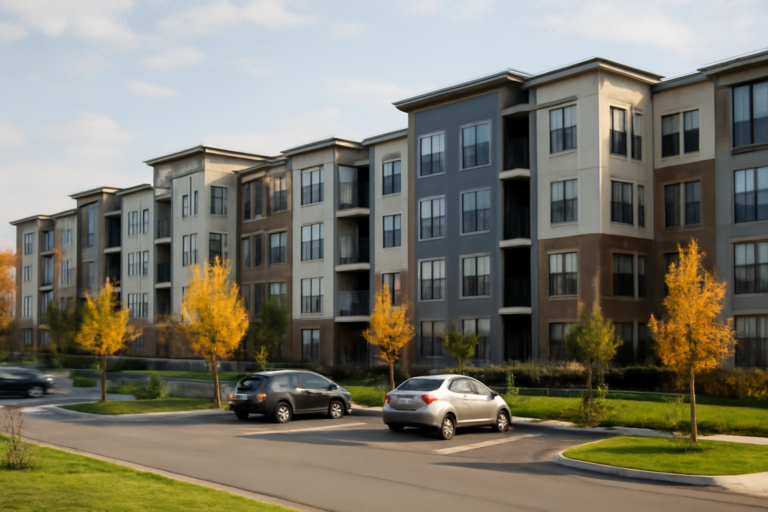

The office market is improving—but not evenly
For several years, the U.S. office market has been defined by excess space, weak leasing demand, elevated concessions and uncertainty around hybrid work. The latest third-quarter data does not erase those challenges, but it does suggest the market is moving into a more stable phase.
Cushman & Wakefield reported that national office vacancy declined year over year for the third consecutive quarter. Vacancy stood at 19.8%, down 25 basis points from a year earlier, while the market recorded its fifth consecutive quarter of positive net absorption.
The quarterly absorption figure was modest—approximately 50,000 square feet—but the broader trend is more important. Over the past year, U.S. office absorption reached 15.5 million square feet. JLL’s separate third-quarter analysis was more constructive, showing 6 million square feet of positive quarterly occupancy gains and 21 million square feet of year-to-date absorption.
The two reports use different methodologies and market coverage, so their totals should not be treated as interchangeable. Together, however, they point in the same direction: office demand is no longer deteriorating nationally at the pace seen earlier in the cycle.
Three developments are reshaping the supply-demand balance
1. Sublease space is finally being absorbed
Available sublease space declined for the tenth consecutive quarter, falling to approximately 89 million square feet, according to Cushman & Wakefield. That is 33% below the first-quarter 2024 peak and the lowest level since late 2020.
Sublease inventory now represents roughly 1.6% of total U.S. office inventory, close to its long-term average of 1.5%. This matters because sublease availability often turns before overall vacancy. When companies withdraw space from the sublease market—either by occupying it, renewing, expanding or allowing leases to expire—the amount of discounted competing space begins to shrink.
That does not mean office rents will suddenly accelerate. Many tenants still have leverage, and landlords continue to compete through tenant-improvement packages, free rent and other concessions. But a smaller sublease pool can reduce downward pressure on effective rents, particularly in markets where new supply is limited.
2. Office inventory is contracting
The second major development is that the denominator is getting smaller. JLL reported that 9.6 million square feet of office inventory was removed during the third quarter, while more than 45 million square feet has been removed from the U.S. inventory since the late-2023 peak.
Cushman & Wakefield reported a similar trend, estimating that total U.S. office inventory declined by 42.5 million square feet over six quarters. Obsolete buildings are being converted, demolished, sold to owner-users or otherwise removed from the competitive leasing pool.
For investors, this is more important than it may initially appear. A market can improve without a dramatic surge in tenant demand if enough obsolete supply exits. That process can benefit remaining buildings—but only when the assets being retained are functional, well located and financially capable of competing for tenants.
3. New construction has nearly stopped
New office deliveries remain unusually low. JLL reported only 3.5 million square feet of completions during the third quarter, matching the near-record-low delivery volume from the second quarter. Only 23 million square feet was under construction nationally.
Cushman & Wakefield said the first three quarters of 2026 produced approximately 7.1 million square feet of deliveries, putting the full-year total on pace to match the lowest annual amount in more than 30 years.
This supply restraint creates a potential advantage for well-positioned existing buildings. Tenants seeking modern, efficient, amenity-rich space may have fewer new alternatives, especially in markets where construction is difficult to finance or where zoning and conversion activity are reducing inventory.
It also creates a warning for investors underwriting older properties. A lack of new construction does not automatically make every existing building more valuable. Tenants are still choosing among available properties, and the best buildings are capturing a disproportionate share of leasing activity.
The real story is a widening gap by asset quality
The national recovery is increasingly a flight-to-quality story. Cushman & Wakefield reported that vacancy in top-tier properties fell 215 basis points over the past two years, while vacancy in Class B and Class C buildings continued to rise.
JLL likewise noted that asking rents increased modestly, reaching $40.51 per square foot nationally, while effective rents grew especially quickly in trophy and new-construction segments where available space is scarce.
This divide has direct implications for passive investors. A headline showing lower national vacancy may not translate into better performance for a suburban office asset with outdated mechanical systems, limited parking, weak amenities or a large upcoming lease rollover.
At the property level, investors should examine:
- The percentage of occupied space in buildings with strong tenant retention and renewal prospects.
- Lease expirations over the next three to five years.
- Tenant-improvement and leasing-commission reserves required to compete.
- Capital needs related to HVAC, elevators, life-safety systems and energy standards.
- The building’s location relative to transit, housing, restaurants and other amenities.
- Whether the property can support flexible layouts, collaboration areas and modern technology infrastructure.
What this means for valuations and financing
Improving fundamentals can eventually support office valuations, but the process will likely remain selective. Lower vacancy and reduced competitive supply may help high-quality assets stabilize cash flow. That can improve lender confidence and create a clearer path to refinancing or disposition.
However, lenders and buyers are unlikely to underwrite a broad office recovery equally across all buildings. Debt sizing will still depend heavily on in-place cash flow, tenant credit, lease rollover, capital requirements and the sponsor’s ability to fund future leasing costs.
For passive investors, the key question is not simply whether office is recovering. It is whether a particular investment can survive long enough to benefit from the recovery. A property may have attractive long-term fundamentals but still require substantial equity if its loan matures before occupancy and rents improve.
Markets are moving at different speeds
National statistics also mask considerable variation. JLL reported that gateway markets recorded especially strong leasing growth, while technology-led markets were among the leaders in year-to-date absorption. In several individual markets, the improvement is being helped by inventory removals rather than by broad-based tenant expansion.
That distinction matters. A falling vacancy rate caused by strong leasing demand is generally more durable than one caused primarily by demolitions, conversions or owner-user purchases. Investors should separate the sources of improvement before assuming that a market has reached a durable bottom.
What passive investors should watch next
The next several quarters should clarify whether stabilization is becoming a genuine recovery. Three indicators deserve particular attention:
- Positive absorption without heavy concessions. Occupancy gains are encouraging, but investors should monitor whether landlords are retaining tenants at economically sustainable rents.
- Continued decline in sublease inventory. A further reduction would suggest that excess space is being worked through rather than merely delayed.
- Performance of Class B and C properties. If improvement remains limited to trophy and Class A buildings, office recovery will remain highly selective.
The current data supports a cautiously constructive conclusion. The office market is no longer moving uniformly in the wrong direction, and shrinking supply is improving the outlook for the best-located, best-capitalized assets.
But stabilization is not the same as normalization. For passive investors, the opportunity is likely to be found in careful asset selection, conservative refinancing assumptions and managers with enough capital to execute the property-level work required to remain competitive.