Data-center financing is moving into the CRE mainstream
Commercial real estate investors have spent years hearing that data centers are the next major growth segment. The more important development now is not simply the construction pipeline. It is the way data-center assets are being financed, packaged, and distributed through the commercial real estate debt markets.
Recent securitization activity indicates that data centers are becoming a meaningful component of commercial property credit. Altus Group reported this week that approximately $17 billion of data-center CMBS has been issued since the beginning of 2025—more than triple the combined issuance of the prior two years. The sector now represents roughly 8% of new commercial property bond deals, according to the firm.
That is still a specialized corner of the market, but it is no longer immaterial. For passive investors, the trend matters because debt-market acceptance can influence valuations, liquidity, refinancing options, and the range of institutions willing to provide capital.
A recent transaction shows the scale of the market
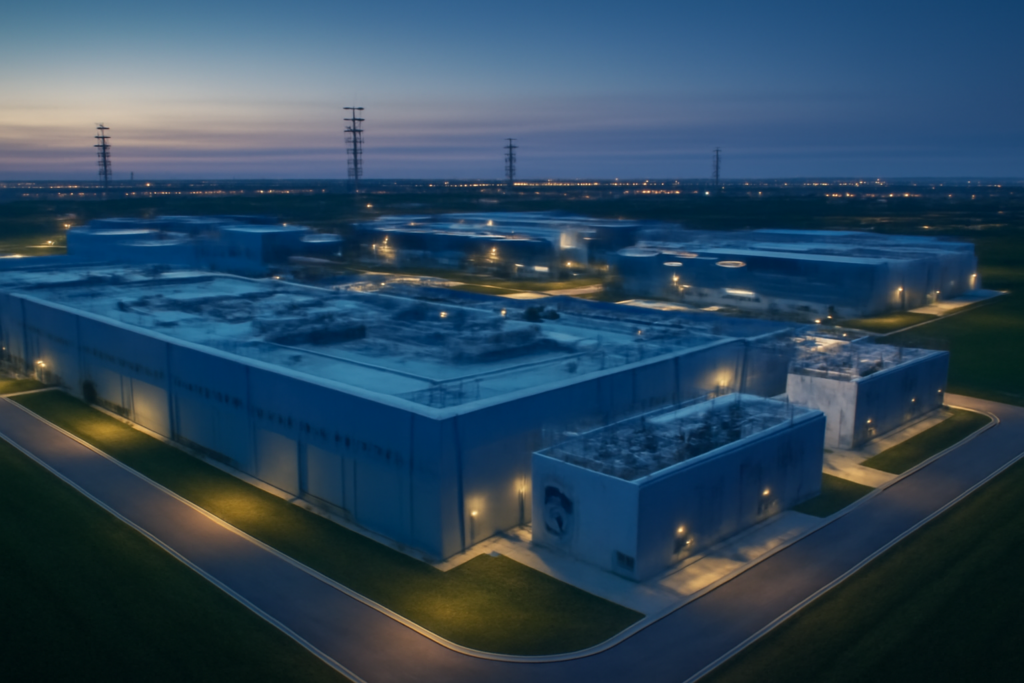
The Commercial Real Estate Finance Council highlighted two major private-label securitizations that priced during the week of September 7, including a $375 million single-asset, single-borrower transaction backed by 800 Devon, a redeveloped hyperscale data center in Elk Grove Village, Illinois.
The property contains approximately 174,000 square feet and has 30 megawatts of capacity. The transaction was backed by a fixed-rate, interest-only loan co-originated by Barclays and Goldman Sachs for TechCore, a data-center platform formed by GI Partners and CalPERS.
The deal is notable for several reasons:
- It demonstrates that institutional lenders are willing to securitize specialized data-center assets.
- It places a large, single-property data-center loan within the broader commercial real estate bond market.
- It gives investors another way to gain exposure to digital infrastructure through credit rather than direct ownership.
- It highlights how property-level characteristics—such as power capacity, redevelopment quality, and tenant demand—are becoming central to CRE underwriting.
The same CREFC update also described a nearly $985 million industrial securitization backed by 39 properties across four states. That transaction is not a data-center deal, but the comparison is useful: modern industrial and digital-infrastructure assets are increasingly being evaluated through a capital-markets lens that emphasizes specialized functionality, tenant demand, lease duration, and replacement cost.
Why investors are willing to finance data centers
The core investment thesis is straightforward. Cloud computing, artificial intelligence, enterprise software, streaming, and digital services all require physical facilities with substantial power and connectivity. Unlike conventional warehouses, data centers can support high revenue density and mission-critical operations.
That demand has attracted both real estate and infrastructure capital. Altus reported that Citigroup expects data-center CMBS issuance to rise to approximately $18 billion to $20 billion next year, or roughly 50% above current levels.
If that forecast is realized, data centers would represent a more established financing category rather than an occasional specialty transaction. A broader lender base could help owners refinance, sell, or recapitalize assets. It could also improve price discovery as more comparable debt transactions become available.
However, greater capital availability does not eliminate risk. It may simply allow more capital to flow toward assets that require more sophisticated underwriting.
Data centers are not simply specialized industrial buildings
Passive investors should be cautious about grouping data centers with ordinary warehouses or light-industrial properties. The physical building is only one part of the investment.
A data center’s value may depend heavily on:
- Reliable access to electrical power
- Utility interconnection timelines and costs
- Cooling systems and energy efficiency
- Fiber connectivity and network redundancy
- Tenant credit quality
- Lease structure and renewal probability
- The ability to upgrade equipment as computing requirements change
- Local restrictions, environmental requirements, and community opposition
These characteristics can create durable competitive advantages, but they can also create concentrated sources of risk. A property with limited power availability may not be able to expand. A facility designed for a previous generation of computing equipment may require significant capital to remain competitive. A single-tenant building may produce strong cash flow, but the loss of that tenant can create a much more severe vacancy event than it would at a diversified industrial park.
The result is a sector with potentially attractive growth but a narrower margin for analytical error.
What the securitization trend means for passive investors
The growth of data-center debt issuance has several implications for investors participating through private real estate funds, REITs, debt funds, and other passive vehicles.
1. Financing availability may support valuations
When more lenders compete for a property type, borrowers may gain access to better pricing, longer-term capital, or more flexible structures. That can support transaction volume and valuations, particularly for assets with strong tenants and clear power advantages.
The reverse is also true. If capital markets become less receptive, highly specialized properties may experience sharper repricing because there are fewer alternative uses for the building.
2. Credit investors may gain an alternative to equity exposure
Investors who are uncomfortable with development risk or technology-driven operating risk may find data-center debt more attractive than data-center equity. A fixed-rate loan secured by a stabilized asset has a different risk profile from an ownership position that depends on future rent growth, expansion, or a favorable exit multiple.
That does not make the debt risk-free. The CREFC transaction backed by 800 Devon, for example, is a single-asset, single-borrower structure. Concentration remains important even when the property is institutionally sponsored.
3. Underwriting standards may become more transparent—but not necessarily simpler
More securitizations create additional data points for lenders and investors. Over time, the market may develop clearer benchmarks for debt yields, leverage, lease terms, and pricing.
Still, conventional CRE metrics will not tell the whole story. Investors should expect diligence around power contracts, tenant expansion plans, equipment requirements, and capital expenditure needs. A high occupancy rate is less meaningful if the facility lacks the infrastructure required by the next generation of users.
What to watch next
Passive investors should monitor four indicators as data-center financing expands:
- Loan structure: Higher leverage, interest-only periods, and short maturities may increase refinancing sensitivity.
- Tenant concentration: A strong headline tenant does not eliminate single-tenant rollover risk.
- Lease economics: Investors should distinguish between contractual rent growth and revenue that depends on additional tenant investment or expansion.
- Power and capital requirements: The most valuable competitive advantage may be access to power, but maintaining that advantage can require substantial ongoing capital.
The broader lesson is that data centers are becoming a legitimate CRE capital-markets category, but they should not be evaluated as ordinary industrial real estate with a technology premium attached.
For passive investors, the opportunity is likely to be strongest where specialized demand is matched by conservative leverage, durable tenant commitments, verified power availability, and a clear plan for maintaining the facility over time. The growth of securitization can improve liquidity, but it does not replace property-level underwriting.