Retail’s recovery is becoming harder to ignore
For much of the past decade, retail real estate was treated as a problem sector. E-commerce disrupted tenant demand, department-store closures weakened malls, and the pandemic accelerated concerns about the long-term role of physical stores.
That narrative is changing—but not because every retail property has recovered.
The more important development is that investors are increasingly separating durable retail from vulnerable retail. Recent transaction activity, leasing data, and institutional commentary suggest that well-located shopping centers—especially grocery-anchored and necessity-based properties—are attracting more capital as buyers recognize a combination that is difficult to replicate: limited new supply, steady consumer demand, and relatively low vacancy.
For passive commercial real estate investors, the opportunity is meaningful. So is the risk of overpaying for a recovery that is already becoming competitive.
Capital is moving back into selected retail assets
LightBox’s September 8 analysis highlighted two sizable shopping-center transactions that illustrate the change in investor sentiment.
JLL Income Property Trust acquired Midtown Village in Tuscaloosa, Alabama, for $94 million— reportedly 32% above the property’s 2021 sale price. Nuveen sold Village Crossing in Skokie, Illinois, for $122 million, described as the largest suburban Chicago retail sale in a decade.
Those deals do not mean retail values have broadly returned to prior peaks. They do show that institutional buyers are willing to pay up for assets they believe offer durable cash flow and limited competitive supply.
LightBox also reported that retail accounted for the largest share of U.S. CRE transaction activity in the second quarter, at 23%, ahead of multifamily at 20% and office at 17%. Retail transaction volume increased 14% quarter over quarter in the company’s midyear tracker.
That is a notable signal because it suggests retail is not merely benefiting from distressed pricing. Buyers are competing for assets they view as strategically valuable.
The fundamental story is supply discipline
The strongest argument for retail today is not a sudden surge in consumer spending. It is the lack of new competing space.
The National Association of Realtors’ September 2026 market report found that retail vacancy held at 4.3% in July. Demand improved, although new deliveries still exceeded absorption. General retail recorded the strongest performance among the segments tracked, while neighborhood centers, power centers, and malls also showed broader improvement.
A 4.3% vacancy rate is not a guarantee of strong property-level returns. National figures can conceal major differences by market, tenant mix, and property quality. Still, retail’s relatively low vacancy compares favorably with the structural challenges facing many office properties and with the elevated supply levels affecting portions of multifamily and industrial real estate.
The supply picture is especially important for passive investors. When a market has limited new construction, existing properties can retain pricing power even if demand growth is moderate. Tenants looking for space have fewer modern alternatives, and landlords may face less pressure to offer aggressive concessions.
JLL’s 2026 U.S. retail outlook made a similar point, reporting that only 7.8 million square feet of new retail space was delivered in the first quarter—25% below the ten-year average. The firm also said retail represented 14% of U.S. sector investment, its highest share in a decade, with trailing twelve-month transaction volume reaching $62 billion.
The implication is straightforward: retail’s recovery is being supported by scarcity as much as by demand.
Grocery anchors remain the center of gravity
Not all retail is benefiting equally. The most defensible properties tend to serve recurring, everyday needs rather than discretionary shopping alone.
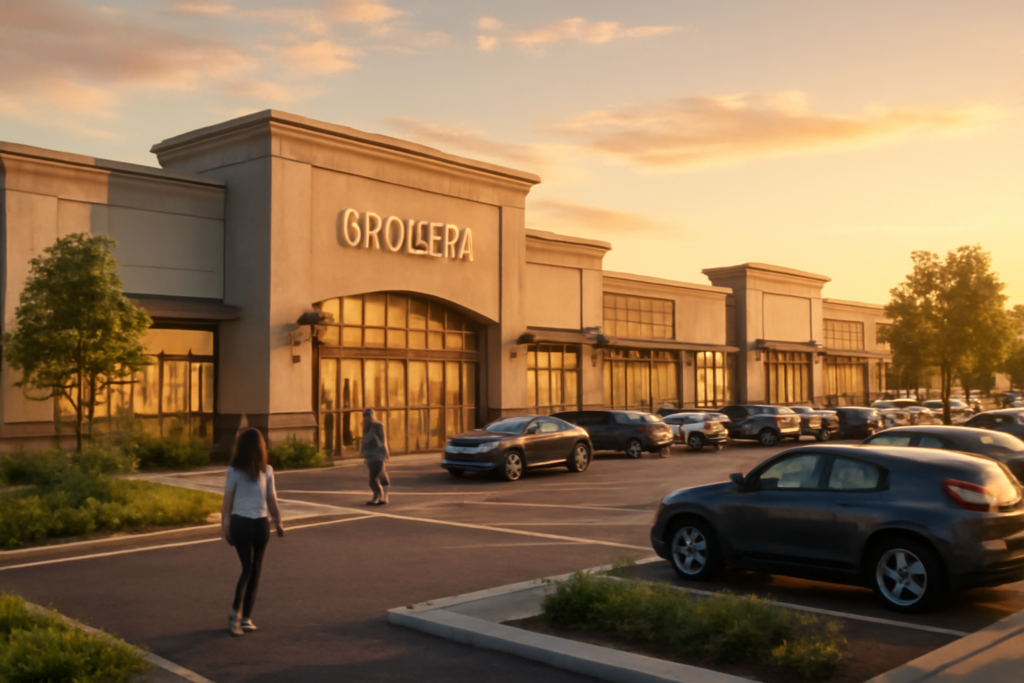
Grocery-anchored centers are attractive because the anchor creates frequent customer visits and supports smaller tenants such as restaurants, salons, medical providers, and service businesses. These properties can also benefit from tenant diversification: a vacancy at a small shop is generally less damaging than the loss of a department-store anchor or major entertainment tenant.
That does not eliminate risk. Grocery tenants can still face margin pressure, local competition, or store-level underperformance. But the operating model is generally easier for passive investors to underwrite than a center dependent on fashion, big-box discretionary spending, or a single troubled tenant.
The same logic applies to necessity-based retail, including pharmacies, discount stores, fitness, quick-service restaurants, and certain medical or service uses. The key is not simply whether a tenant is well known. Investors need to understand whether the center generates repeat visits and whether the surrounding trade area can support the tenant mix over time.
Why higher prices create a new underwriting challenge
The positive retail story has a built-in problem: more investor demand can compress yields.
When buyers compete for grocery-anchored centers in strong markets, purchase prices can rise faster than property-level income. That creates a narrower margin of safety, particularly while financing costs remain elevated.
Higher Treasury yields are still pressuring commercial mortgage rates. Even if a property has stable occupancy and modest rent growth, the investment can underperform if the acquisition price assumes an overly optimistic exit cap rate or aggressive refinancing terms.
Passive investors should therefore focus less on the headline sector recovery and more on the specific relationship between price, cash flow, and debt.
Important questions include:
- How much of current net operating income comes from temporary rent spreads or below-market leases?
- When do the largest tenants expire, and how much renewal risk exists?
- Is the grocery anchor financially healthy and strategically committed to the location?
- What happens to debt-service coverage if interest rates remain high at refinancing?
- Does the purchase price assume rent growth that the local market has not historically produced?
- How much capital expenditure will be required to keep the center competitive?
A retail property can have low vacancy and still be a weak investment if the basis is too high or the tenant rollover is poorly timed.
Market selection will matter more than the sector label
LightBox identified Charlotte, New York City, Chicago, and Miami as leading markets for retail investment this year. JLL also pointed to secondary and tertiary markets—including Charlotte, San Diego, Orlando, Denver, and Kansas City—as areas where grocery-anchored centers have posted strong rent growth.
That does not mean investors should treat those markets as interchangeable. Population growth, household income, retail sales, new construction, insurance costs, property taxes, and competing centers can vary dramatically within the same metropolitan area.
For passive investors evaluating a fund or syndication, the sponsor’s market-selection process deserves as much attention as the property itself. A strong national retail trend cannot rescue an asset located in a declining trade area or surrounded by newer competing centers.
What investors should watch next
The retail recovery is worth monitoring, but several indicators will determine whether it remains durable:
- New construction: Continued supply discipline would support existing centers. A sharp increase in deliveries could pressure occupancy and rents.
- Tenant health: Retail bankruptcies and store closures have moderated from their earlier pace, but tenant credit remains central to property performance.
- Transaction pricing: Rising sale prices are positive for owners but may reduce future returns for new buyers.
- Consumer demand: Necessity-based retail is defensive, not recession-proof. Employment and household finances still matter.
- Financing conditions: Refinancing costs could determine whether today’s attractive-looking acquisitions produce durable cash distributions.
The broader lesson is that retail is no longer simply a distressed-value story. It is becoming a quality-and-basis story.
For passive investors, that means the best opportunities may not be the properties with the highest projected returns. They may be the assets with the clearest tenant demand, the strongest supply barriers, conservative leverage, and enough pricing discipline to withstand a slower recovery.
Sources
- LightBox, “The LightBox Signal: Weekly Analysis of the Top CRE Headlines,” September 8, 2026
- LightBox, “2026 Midyear CRE Transaction Tracker,” September 3, 2026
- National Association of Realtors, “September 2026 Commercial Real Estate Market Insights Report”
- JLL, “U.S. Retail Thematic Outlook and Investor Survey Results,” June 30, 2026